
By Gabriel Harmetz
In Italy, soccer isn’t something you discover through school teams or organized leagues.
It’s already there when you’re growing up — in the street, in the courtyard, in the symbols stitched onto city flags and club jerseys. Long before you ever kick a ball yourself, someone will ask you a question that quietly shapes your identity: Which team are you?
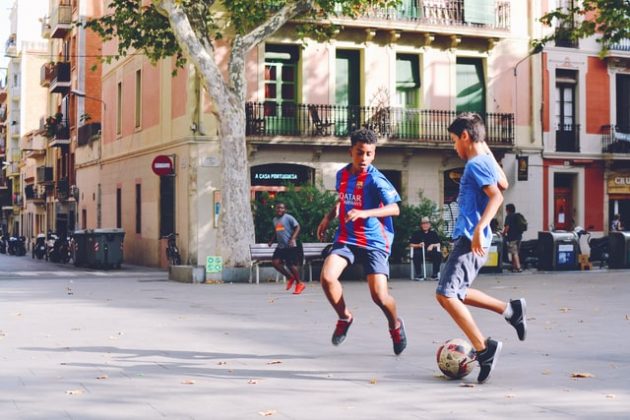
Unlike in the United States, where sports like football or baseball are deeply tied to schools, colleges, and structured programs, Italian soccer grows from the ground up. It starts informally, in neighborhoods and small towns, long before institutions enter the picture. Passion comes first; organization follows later, if at all.
This is not uniquely Italian. Countries like Brazil, Germany, France, and much of Africa share a similar relationship with the game. In these places, soccer is learned outside of classrooms and athletic departments — played in alleyways, dirt fields, schoolyards, and empty lots. Wherever soccer grows from the street rather than the school system, belonging comes before rules, and loyalty forms early.
Italy fits squarely into this tradition.
Part of that bond comes from the way Italian teams are rooted in local identity. Club names, colors, and crests often draw from medieval symbols, coats of arms, patron saints, animals, or ancient civic emblems. Changing a team’s colors or symbol is not seen as a marketing update — it can spark outrage. For fans, the club represents a city, a region, or even a family history, not just a roster of players.
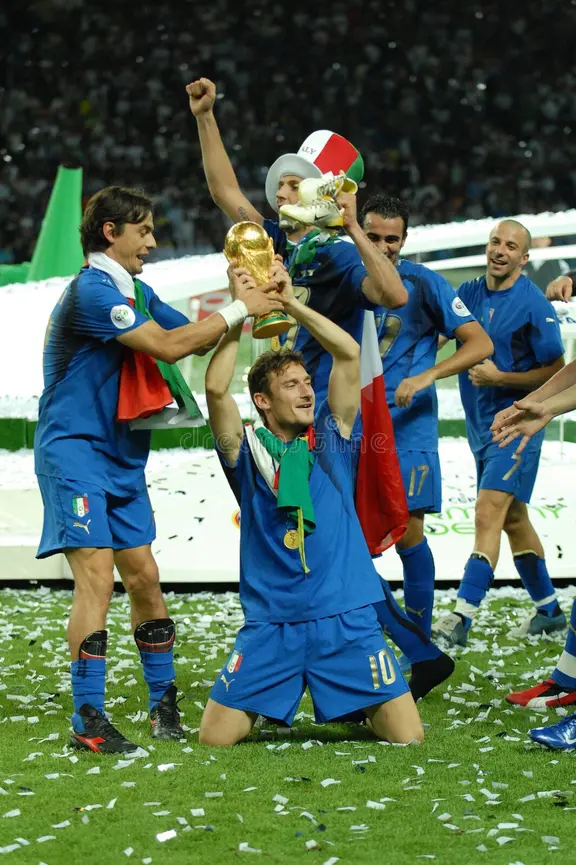
This sense of continuity helps explain why soccer memories in Italy often feel personal, even intimate. Certain matches live on not simply as sporting events, but as shared experiences people remember watching together — in crowded living rooms, neighborhood bars, or public squares. World Cup games against Germany, for example, are not recalled for their statistics alone, but for the arguments, celebrations, and silences that followed.
Some players, too, transcended the sport entirely. Diego Maradona is the most obvious case. In Italy, he wasn’t admired merely for his skill; he was mythologized. He gave fans stories, symbols, and debates that lasted decades. Even those who never saw him play still talk about him as part of a shared cultural memory, not unlike a legendary artist or political figure.
Watching soccer in Italy has long been a social ritual. Even today, many matches are followed the same way they always have been: standing in bars, surrounded by people who may be strangers but feel temporarily familiar. Older men argue loudly about referees, tactics, and missed chances. Younger fans listen, absorbing not just the rules of the game but its language and rhythms. The match becomes an excuse for conversation, disagreement, and belonging.
This stands in contrast to the American sports experience, which is often more structured and scheduled, tied to seasons, programs, and clear hierarchies. In Italy, soccer is messier. It invites passion and frustration in equal measure. There is room for genius, improvisation, and drama — sometimes too much of it.
Ironically, the country that formalized soccer’s rules, England, offers a counterpoint. In the late nineteenth century, the sport developed within elite public schools like Eton before becoming professional and mass-oriented later on. In Italy, the process was almost reversed. The game was loved long before it was organized.
That may be why Italian soccer can be difficult to export in its full complexity — but also why it remains impossible for many Italians to abandon. Soccer there survives not because it is always efficient, fair, or even beautiful, but because it is shared. And shared things, especially those rooted in everyday life, tend to last.
Gabriel Harmetz a freshman studying finance at the Robert H. Smith Business School at the University of Maryland, with a passion for skiing and basketball (and sports in general) and for my Italian roots and language.